
Thermo Fisher Scientific › Electron Microscopy › Electron Microscopes › 3D Visualization, Analysis and EM Software › Use Case Gallery
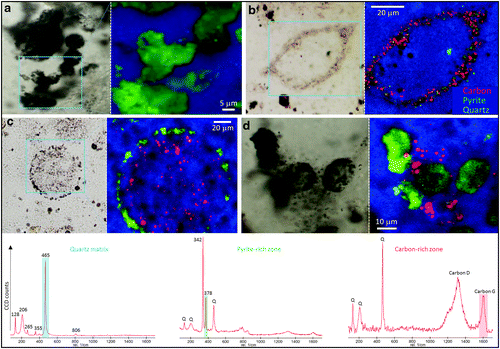
The ∼3.48 billion-year-old Dresser Formation, Pilbara Craton, Western Australia, is a key geological unit for the study of Earth’s earliest life and the habitats it occupied. Here, we describe a new suite of spheroidal to lenticular microstructures that morphologically resemble some previously reported Archean microfossils. Correlative microscopy shows that these objects have a size distribution, wall ultrastructure, and chemistry that are incompatible with a microfossil origin and instead are interpreted as pyritized and silicified fragments of vesicular volcanic glass. Organic kerogenous material is associated with much of the altered volcanic glass; variable quantities of organic carbon line or fill the insides of some individual vesicles, while relatively large, tufted organic-rich laminae envelop multiple vesicles.
For Research Use Only. Not for use in diagnostic procedures.